Pain Is Not the Problem — Loss of Capacity Is
Jan 11, 2026
Most people who struggle with persistent pain are not doing nothing.
They’re exercising.
They’re resting.
They’re stretching.
They’re strengthening.
They’re following plans that are reasonable, evidence-based, and often well-intentioned.
And yet things keep stalling, flaring, or unraveling.
The mistake is not effort.
The mistake is what is being evaluated.
Pain Is an Output, Not the Error
Modern pain science is clear on this point: pain is not a direct measure of tissue damage.
Pain is an output of the nervous system, shaped by threat, uncertainty, load, fatigue, prior experience, and context. It reflects how the system is interpreting its current state—not simply what is happening locally in a joint or muscle.
That insight was important. But for many people, it wasn’t enough.
Understanding why pain happens doesn’t automatically tell you what to do next.
The Real Failure Mode: Shrinking Options
What actually derails people over time is not pain itself, but the gradual loss of what remains possible.
You can think of this as adaptive capacity:
-
how many actions your system can tolerate
-
how much variability you can absorb
-
how much load, stress, or novelty you can handle before things escalate
Pain often appears when that capacity is being depleted—but it is not the depletion itself.
People get stuck when their decisions quietly reduce future options, even if those decisions feel helpful in the moment.
Why the “Right” Thing Can Still Make You Worse
This is where many well-designed programs fail.
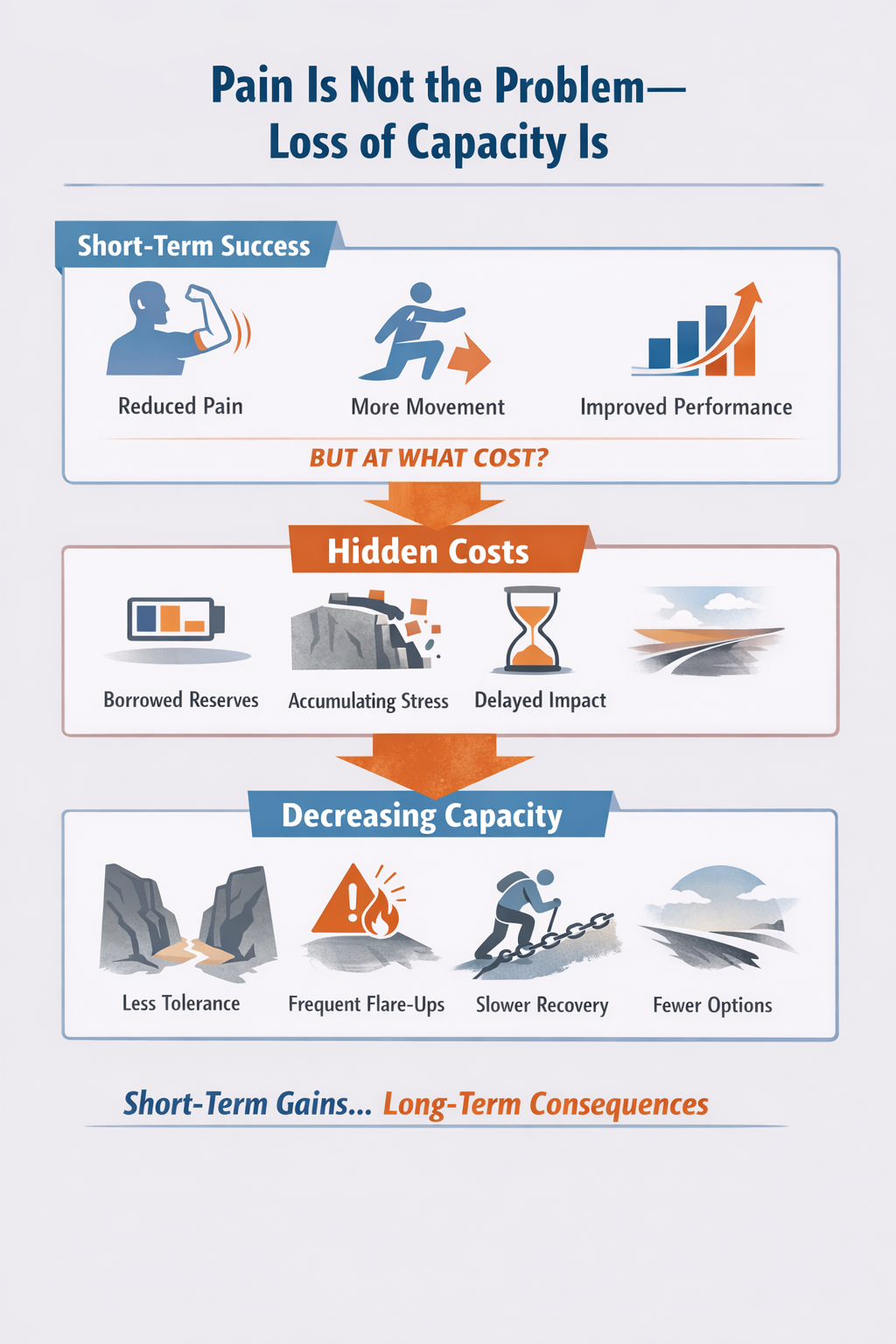
An intervention can be locally effective:
-
pain goes down
-
movement improves
-
confidence increases
-
performance briefly rebounds
And still be globally costly.
If an action reduces what you can safely do tomorrow, next week, or next month, it is not neutral—it is expensive, even if it feels good today.
This is why people often say:
“Everything was going fine… until it wasn’t.”
The breakdown wasn’t sudden.
It was unaccounted for.
Degradation Is Not Damage
In chronic or recurring pain, the system often doesn’t collapse all at once.
Instead, it degrades:
-
tolerance narrows
-
flare-ups become easier to trigger
-
recovery takes longer
-
variability feels dangerous
-
“safe” options shrink
This is not necessarily injury.
It is loss of usable capacity.
Pain neuroscience describes sensitization well. What is often missing is a way to evaluate whether daily decisions are preserving or consuming what capacity remains.
Why Pushing Sometimes Works — Until It Doesn’t
Pushing can work in the short term because biological systems can borrow.
You can override signals.
You can rely on compensation.
You can trade future tolerance for present output.
That doesn’t mean it’s wrong. It means it has a cost.
When pushing stops working, people often blame fragility, aging, or bad luck. A more accurate explanation is simpler:
The system ran out of options it could absorb safely.
Nothing mysterious happened.
The accounting just finally caught up.
Rest Is Not Automatically Recovery
Rest helps only if it changes the constraints.
Doing less inside the same rules does not restore capacity—it just pauses the drawdown. That’s why some people rest and return unchanged, or more sensitive than before.
Recovery is not undoing damage.
Recovery is changing the conditions under which actions are evaluated so different actions become possible again.
If nothing about the constraints changes, nothing is truly recovered.
The Question That Actually Matters
If pain keeps returning, escalating, or migrating, the most important question is not:
“What should I do?”
That assumes all actions are equal until proven otherwise.
A better question is:
Which actions preserve capacity, and which ones quietly consume it?
That question applies to:
-
exercise selection
-
load progression
-
rest
-
training decisions
-
lifestyle stress
-
performance goals
It applies to bodies because bodies are bounded systems.
What Strong Strides Focuses On
Strong Strides does not start with fixing pain.
It starts with understanding:
-
what capacity remains
-
which constraints are active
-
which actions are still sustainable
-
where degradation is occurring
-
when reframing is required instead of progression
Pain is not ignored.
It’s contextualized.
Closing
Pain is not your enemy.
It’s information about the limits of the system you’re operating in.
If you’ve been doing reasonable things and still losing ground, the issue is rarely effort or motivation. It’s usually that the rules you’re playing under are no longer compatible with the actions you’re taking.
The goal is not to eliminate pain at all costs.
The goal is to stop losing future options.
That’s the work.
Stay connected with news and updates!
Join our mailing list to receive the latest news and updates from our team.
Don't worry, your information will not be shared.
We hate SPAM. We will never sell your information, for any reason.